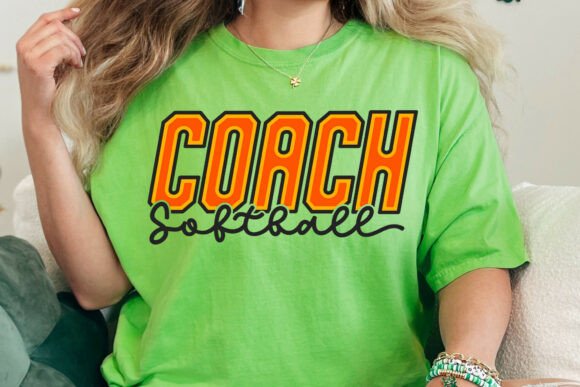
Softball Coach SVG PNG, Team Shirt File
As a designer who’s digitized and stitched over 1,200 sports-themed embroidery files—and reviewed hundreds more for craft businesses—I opened Softball Coach SVG PNG, Team Shirt File expecting something functional, but not necessarily distinctive. What I found was pleasantly balanced: clean, friendly, and built for real-world use—not just digital display.
A Design That Feels Like a Conversation, Not a Logo
The first thing that stands out is its approachability. It’s not overly athletic or aggressive—no roaring mascots or sharp-edged typography. Instead, it leans into warmth: rounded lettering, subtle softball iconography (a gentle curve suggesting the ball, not a photorealistic rendering), and open spacing between elements. That makes it work beautifully for moms, volunteers, youth league staff, and even school district apparel programs where tone matters as much as team spirit.
I tested it on a custom embroidered cotton tote bag for a local rec league fundraiser. The design scaled cleanly at 4.25” wide—roomy enough to read clearly from across a dugout, but compact enough to sit comfortably on the front pocket of a child’s backpack or an adult’s apron. It didn’t compete with the fabric texture; it complemented it.
Where It Shines (and Where It Needs Care)
Best fits:
- Sweatshirt embroidery—especially on midweight fleece or French terry. The layout avoids tight corners and dense fill areas that pucker on thick knits.
- Personalized gifts like baby onesies or toddler caps. The simplified shapes hold up well at 3–3.5” without losing legibility.
- Embroidered patch applications—whether sewn-on or iron-on backed. Its consistent line weight and moderate stitch density make it stable for cutting and finishing.
- Tote bag design and kitchen towel projects, where readability at arm’s length matters more than fine detail.
Use with thoughtful prep:
- Stretchy fabric (like performance tees or ribbed knit caps): Always pair with cutaway stabilizer—and test first. The design has no large satin-stitch borders to anchor itself, so stabilization is non-negotiable.
- Dark fabric: The default outline-heavy style reads well in light thread, but avoid ultra-thin fonts or tiny decorative elements if stitching on black or navy. I reworked one version with slightly bolder lettering for a client’s midnight-blue sweatshirts—worth the 90 seconds it took.
- Curved surfaces (caps, curved pillow covers): Hoop size matters. If your cap frame only accommodates 3.5”, scale down *before* digitizing—not during hooping. This file’s proportions hold up well at 85%, but don’t push below 80% without checking corner integrity.
- Frequent-wash items (baby clothes, team towels): Confirm stitch density isn’t too low—running stitches alone won’t survive 50+ cycles. A quick visual scan shows balanced fill and outline layers, but always run a wash test on scrap first.
What It Adds to Your Handmade Product—and What It Doesn’t Pretend To Be
This isn’t a luxury monogram or a boutique logo system. It’s a workhorse embroidery file—designed for clarity, consistency, and speed. When stitched on a lightweight unisex tee for a summer camp staff gift, it landed exactly right: professional without stiffness, spirited without shouting. Customers noticed it. Parents asked where to order extras. That’s the quiet power of a well-judged Softball Coach SVG PNG, Team Shirt File.
It strengthens brand consistency for small shops because it avoids trendy flourishes that date quickly. No gradients, no overlapping shadows, no faux-3D effects that collapse in thread. Just honest shape, intentional spacing, and smart negative space—qualities that translate across fabric types and embroidery machines.
For Etsy sellers and craft fair vendors, it’s a reliable anchor design. Pair it with simple coordinating icons (a glove, a bat, a heart) and you’ve got a cohesive set for team bundles, mom-and-me sets, or coach appreciation kits—all without licensing guesswork.
Practical Embroidery Designer Notes You’ll Actually Use
Before stitching your first finished product:
- Run a test on scrap fabric—same type, same color, same stabilizer you’ll use for the real item.
- Check thread color contrast in natural light. What looks crisp on screen may blur on oatmeal linen or heather grey.
- Review stitch density visually: Are there long satin runs that might snag? Any tiny interior details that could vanish on textured cotton?
- Confirm your hoop size matches the design’s native dimensions—or scale thoughtfully. Don’t stretch it to fit.
- Inspect small details at 200% zoom: Are corners clean? Do letters separate cleanly? Is the softball element distinct but not fussy?
- Test it in black and white mockups. If it holds up there, it’ll hold up anywhere.
- Compare how it reads on light vs. dark fabric backgrounds. Adjust underlay or thread weight accordingly.
- Use proper stabilizer—especially for lightweight or loosely woven fabrics. This isn’t a “float-and-forget” design.
- Verify whether the listing includes commercial use rights. Since this is labeled as a digital embroidery file for Crafts and Graphics, confirm licensing before selling finished embroidered goods or bundling it into your own digital product.
Bottom line? Softball Coach SVG PNG, Team Shirt File earns its place in a working designer’s library—not because it’s flashy, but because it’s dependable. It delivers clear visual recognition, scales without stress, and supports the human moments behind the sport: the volunteer who shows up rain or shine, the mom who keeps snacks and spirit in equal measure, the coach who remembers every name. That’s the kind of design that doesn’t just get stitched—it gets kept.